NEWS BULLETIN
FOR IMMEDIATE RELEASE
Welcome to the world of AM high fidelity and meduci wideband AM stereo quality sound, day and night. The future of radio is now. Better reception. Better sound. At meduci, we are very passionate about good quality sound. meduci has AM stereo tuners and decoders for sale.
Many radio manufacturers are leading you, the consumer, to believe that AM radio sounds literally abysmal! Radio manufacturers have, by cutting corners and costs, tossed aside a medium that can sound as good as FM radio broadcasting, and reach a much larger coverage listening area. In many communities, an AM station is the only LOCAL and LIVE media! It deeply angers meduci that public perception of what AM "sounds" like is absolute garbage, when in actuality- its sound potential goes far beyond what most people have ever heard! We hope that when you hear a good AM stereo station proudly speaking about their "sound" that you realize it is your current RADIO product that limits the quality of what you hear, not the AM medium wave band itself!
America's economy is driven by purchases, and purchase price is certainly a determining factor. However, that DOES NOT mean that saving a few pennies here, or a dollar per unit there, to improve the quality of AM sound in radios, would break the manufacturer, or the consumer. This explains why we did not cut corners when designing and manufacturing our very own AM stereo products.
We have adopted Motorola's C-QuAM®™ analog stereo AM technology, and are proud to offer the latest integrated circuit decoder technology available for C-QuAM™ stereo tuners, to provide optimum and accurate AM stereo performance. We re-launched AM Stereo in October 2005, and we gave C-QuAM™ a second chance in the marketplace by introducing four new AM stereo products since then. These AM stereo products cannot be purchased anywhere else. Customers are very satisfied with their meduci tuners. Satisfaction is so high that seldom are any used meduci tuners sold at eBay and other online auction sites. Each meduci product is also backed with one-year warranty against defects in material and workmanship. We use ORIGINAL McCoy Motorola IC chips and other prime components in every meduci AM STEREO product.
There are many AM medium-wave stations broadcasting wideband full fidelity sound in different parts of the world. When received using an appropriate wide band high fidelity AM stereo receiver or tuner under good conditions in the reception environment, using a good external indoor tunable loop antenna, the recovered noise-free high definition sound is virtually indistinguishable from many high quality FM stereo broadcasts! Hearing is believing! Sample one of our high definition AM stereo products, and judge the enhanced audio fidelity for yourself.
MEDUCI MW-2A PLL TUNER !!!

NEW MEDUCI MW-2A PLL
|
California customers: Please click here for your Proposition 65 WARNING.

MW-2A PLL TUNER RECEIVED IN WELLINGTON, NEW ZEALAND:
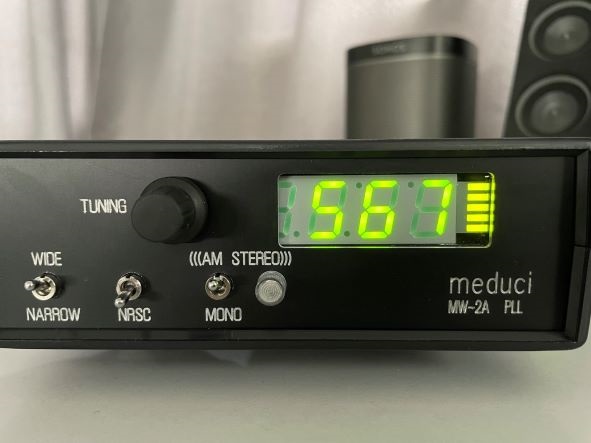
This little guy arrived in Wellington, New Zealand on 09/20/22.
Analog AM stereo technology has claimed its roots almost since the beginning of conventional monaural AM broadcasting within the United States. Later, four different competing AM stereo systems were placed on the air in the early 1980's, including systems from Motorola (C-QuAM™), Magnavox (PMX), Kahn-Hazeltine (ISB), and Harris Broadcast (Variable Angle Compatible Phase Multiplex, or V-CPM). Eventually in 1993, Motorola's C-QuAM technology achieved the exclusive standard for AM stereo broadcasting within the U.S.A. During this time period, Australia, Japan, and other countries were also exclusively using the Motorola C-QuAM system, making C-QuAM the essential de facto world standard for AM stereo broadcasting technology.
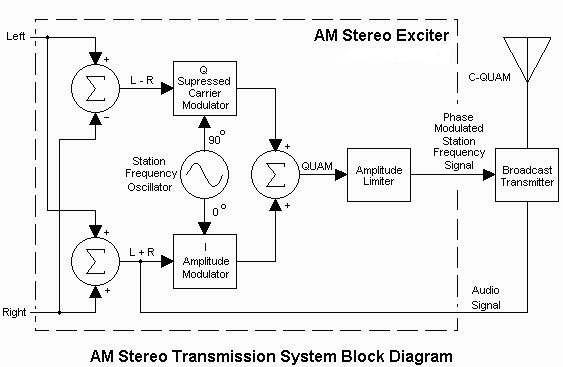
All of the AM stereo systems share in common the addition of a stereo exciter to the existing monaural AM transmitter. This exciter typically has two outputs: the monaural L+R audio, which is time delayed and fed to the transmitter's normal audio input; the second output is the R.F carrier, which replaces the signal from the transmitter's normal quartz crystal oscillator stage. This signal also contains the necessary time delayed and phase modulated (quadrature) information. Because these stereo exciters are retrofitted onto transmitters which were never designed for AM stereo operation, they also must contain corrective equalizers and adjustable delay networks, to insure that all of the relationships are correct through the transmitter modulator, power amplifier, and ATU/antenna system. Decoded stereo separation suffers if the timing and phase relationships are not correct at the receiver.
Motorola's C-QuAM system is covered in several U.S. patents written by the late Frank H. Hilbert and the late Norman W. Parker of Illinois. Norman Parker invented the C-QuAM system, per written correspondence from his wife, Margaret Parker. Margaret also wrote all of the patents. Patent number 4,218,586 was applicable to the basic system. Several other patents included 4,406,922 and 4,192,968. Delco Electronics Corporation (now known as Delphi) later introduced many adaptations and new C-QuAM inventions, covered under various additional U.S patents.
meduci, LLC is a highly entrepreneurial, creative, and innovative research and development organization that specializes in custom free-lance engineering, research, electronic design, development, and production of electronic products, from conceptual ideas through to finalized products, in prototype quantities, up to large scale manufacturing. We also design low frequency (class A, class AB, class D) audio power amplifiers, class C power R.F amplifiers, and R.F front-end (amplifier, mixer, oscillator), using National Semiconductor, Motorola, and other custom ASIC chipsets and discrete components. We strive for quality and excellence in workmanship. Our products are designed for faithful sonic reproduction of the on-air source material. For customers with specific requirements, you could always count on us to produce innovative solutions in a time effective and cost efficient manner. Our customers are benefited by better pricing, quality warranty, and excellent technical support. Contact us for a free quotation -- we appreciate your business. Our goal is to meet the needs of our buyers, distributors and dealers, and we can work on an ad hoc basis.
CORONAVIRUS DISEASE (COVID-19) UPDATE !!
13 March 2020
Dear valued customer,
meduci, LLC is diligently working to manage through this worldwide, daily evolving novel Coronavirus (COVID-19) emergency pandemic crisis situation that we all currently endure. Pursuant to guidelines issued by the U.S Cybersecurity and Infrastructure Security Agency (CISA), and U.S Department of Homeland Security (DHS), meduci, LLC is part of the essential critical sector infrastructure, and is required to remain open for business as an essential service, to continue to receive raw components and supplies, to manufacture electronics products, and to ship these products to the end user sector.
We continue to ship globally, with our highest priority being our internal and external customers. We do not ship UPS Red Next Day service, nor any other expedited delivery service at this time. Shipping guarantees are NOT being made from the carriers. Refunds are also not being granted from these shipping carriers for delivery delays, and missed shipping commitments. There is a huge increase in volume, as more people are shopping online, due to COVID-19 restrictions. Unfortunately, this means that your parcel delivery will be delayed. For domestic shipments prior to 03/12/20, it would take a few days to one week for delivery. These domestic deliveries are now taking weeks to complete. For international shipments from USA, previously it would take weeks for delivery. These deliveries are now taking months to complete. This is being caused by limited domestic and international airline flights, significantly reduced airline capacity on those flights, local route restrictions, delivery controls, flight disruptions, flight cancellations, government restrictions, border closures, government sanctions, and increased safe distancing requirements. Delivery companies are now operating with split shifts, ensuring clean disinfected work areas and stations between shifts. Rest assured, that we are doing everything we can do to minimize order processing and delivery delays. We will provide updates as they arrive, and we will continue to monitor the ongoing situation.
Notice of Force Majeure-- meduci, LLC is fully operational to help with your end user product needs as an essential manufacturer, despite some of these recent world struggles. We will inform you via electronic mail the current status for your submitted orders to meduci, LLC. We will also provide shipment tracking numbers when orders ship from our facility. Some international delivery services are no longer available, due to COVID-19 response. Thank you for your patience during this difficult time.
We are keeping meduci, LLC members safe from the virus, with every possible preventative and protective measure put into place. Out of an abundance of caution, and in adherence with guidance provided by local authorities, we have created policies to slow the virus spread internally within our organization. We have limited travel, canceled meetings, restricted outside visitors, encouraged sick people to stay away, and have enhanced our cleaning and disinfection procedures in order to maintain a safe working environment. Essential operational fulfillment and production support areas of the business continue under greatly enhanced procedures for sanitation, social spacing, and six-feet (1.828 meter) safe distance.
30 May 2021
We are experiencing challenges in procuring raw materials, due to the current worldwide semiconductor device shortage, and other pandemic-related challenges, that have slowed the supply of products in many industries, including the electronics field. We apologize for this delay, and are working with our suppliers to replenish stock and to fill backorders. Where devices were available, we were shocked to observe more than 70,000 pieces of one item were purchased literally "almost overnight." This through-hole device is now on backorder, facing order lead time well into early 2023 from this one semiconductor device manufacturer. When it recently became time to re-order components again for the meduci MW-2A PLL tuner, the same trouble existed locating certain parts. Half of the parts are still out of stock, some with a lead time up to 52 weeks. Short supplies and delivery delays are causing the costs to rise for remaining available components, at more than double the previous prices. Suppliers are passing these costs on to their customers, including significant Section 301 import tariffs, their increasing transportation costs, and their other costs to each purchase. We held off raising our prices as long as possible; however, we wish to communicate at this time that our business is being impacted by these increasing operating, shipping, storage, and other costs. We will continue to do our best to offer the MW-2A PLL tuner and AM_ST decoder, to try to avoid the inevitable "last call" lifetime buy for these two products. We recommend that you do not delay any purchasing decisions, and allow additional time to receive your AM stereo tuner. Thank you.
These tight operating challenges had directly affected our AM_ST decoder sales on eBay in 2021. meduci made a business decision not to renew the eBay auctioning for AM_ST decoders in May 2021, as it became cost prohibitive to maintain that listing every month. We indeed chose to keep the $28.00 price point for each sale since the very beginning of eBay offering, with $25.00 best offer price, despite raw materials prices, and other costs, to increase year-over-year prior to the global pandemic. eBay also raised their rates many times, as well, during this long time period, and nearly 30-percent of gross sales proceeds were going to eBay listing fees, sales commission fees, state sales tax, credit card fees, prepaid shipping costs, and other up-front expenses- from each AM_ST decoder sale. eBay sales, exposure, promotion, and visibility were also decreasing every month. As AM_ST decoder sales resumed again on eBay for the holiday season, these increasing costs unfortunately had to be passed on to each new purchaser. We also continue to sell the AM_ST decoder via direct purchase availability (link is here).
We never receive your credit card numbers, expiration dates, CVV numbers, nor any other personal financial information. We also maintain your privacy, by NOT selling address lists and your other personal information. We also do not use tracking cookies, nor other devices on any of our web pages, to harvest your web site browsing history, and other personal information.
25 August 2021
All international shipping service was temporarily suspended on 25 August, 2021 due to impacts related to the COVID-19 worldwide pandemic, airline travel restrictions, government sanctions, airline flight cancellations, and other unrelated service disruptions. This was an unfortunate circumstance. Thank you for your understanding.
13 February 2022
All international shipping services were restored, and we do see light at the end of this proverbial pandemic tunnel.
31 March 2022
eBay auction was ended for AM_ST decoder, due to unscrupulous activity from one eBay purchaser. We will not get into this specific case that the purchaser filed with eBay. It is very evident reading eBay policies, that they will first side with the purchaser, rather than the seller of goods, whenever purchaser files dispute on eBay. eBay also holds ALL funds from seller, whenever a new case is filed by purchaser. Guilty, until proven innocent, which can take weeks or months to settle with them. Example: If the tracking delivered message does not exist, you are to refund the purchase price, regardless if package was delayed due to weather conditions, or delivered to the wrong address by the shipping company's own mistake, or for any other reasons beyond your control. This is a bonus for the purchaser, as they get to keep the item when it finally gets delivered after delay, and it does not cost them one cent. High commission and other fees (amounts to upwards of thirty percent gross on each sale), and the lack of positive eBay feedback from purchasers, also contributes to an unfavorable selling experience. This combination does not make it worthwhile to continue selling these small decoder modules, using eBay, at this time. Direct sales are always possible here.
10 April 2022
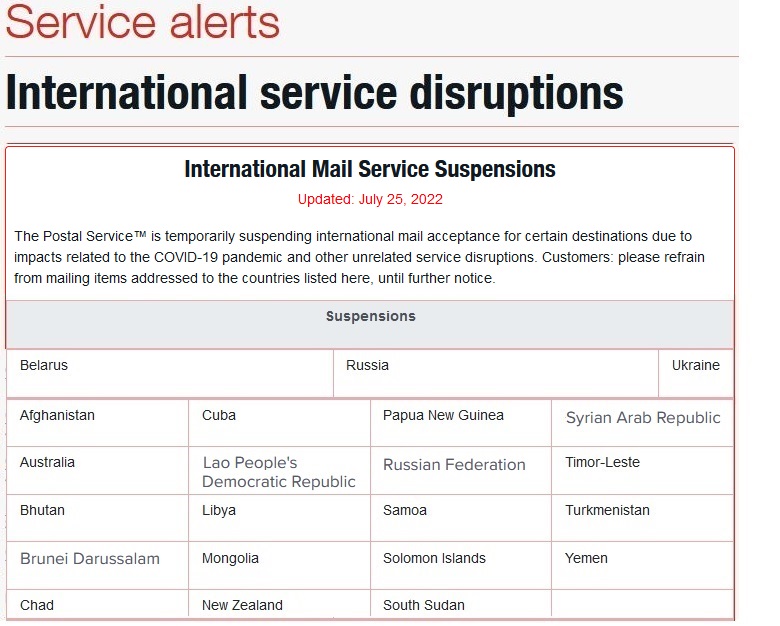
All international shipping service was temporarily suspended on 10 April, 2022 due to impacts related to the COVID-19 worldwide pandemic, airline travel restrictions, airline flight cancellations, and other unrelated service disruptions. This was another unfortunate circumstance, just when we felt that this world was turning around. Many of these shipping restrictons in 2022 were eventually lifted in 2023. However, some shipping restrictions are still in place (see below). Thank you for your understanding.
17 July 2022
Hello again, from meduci, LLC. Another run of our new meduci MW-2A PLL tuner will be available again in September 2022 (link is here). We are procuring the through-hole components, and other raw materials, that make it happen to assemble, test, and to ship the new C-QuAM stereo radio tuners. A smaller run of the tuners sold out on the first day in December 2020. Since then, the COVID-19 worldwide pandemic has contributed to an impact on the semiconductor parts shortage, as well as to very steep increased prices (some parts are currently ten times the price- if they are even available- compared to 2019 prices for these same identical through-hole component parts). Other semiconductor parts that we use were not projected to be available again until mid-2023 !! And we have noted increased prices for all other parts used in our tuner, running at least twice the prices, as compared to 2019. Another one of meduci's global uppliers went out of business in June 2022. And it only takes one unavailable component, without an available component piece or part to be substituted, to halt production on our tuners. We can certainly send you an invoice for one MW-2A PLL tuner, with added option "SSM" and all of the updates - please inquire.
11 September 2022
Production has started again on the new meduci MW-2A PLL AM radio tuner offering. Each custom tuner is in new condition, hand-made, and assembled to order. It will take a few business days for your payment to clear. Up to an additional 21 calendar days will be needed for the MW-2A PLL manufacturing process to be completed, then your order will ship. We continue to add new options, features, and updates to this radio tuner model, despite challenges with the global supply chain, and other factors. We never receive your credit card numbers, expiration dates, nor any other personal financial information. And we never sell your purchase details (your name, shipping address, item description, etc). We do not even have tracking cookies on this web site! This shows how we value and maintain your privacy.
25 June 2023
Very exciting news: we have acquired all of the necessary integrated circuit "chips" and other critical component parts, to continue with processing orders for the foreseeable future for new meduci MW-2A PLL AM radio tuners, and for new meduci AM_ST decoder card module boards (ordering details are here and here).
15 December 2024
International shipping service was suspended in Canada, due to the country's postal strike that started in November 2024. This affected all inbound and outbound shipments using the postal service.
16 February 2025
All international shipping to Canada was resumed, as the country's postal strike had ended, and the package backlog was cleared in January 2025.
06 April 2025 With shifting global trade policies and increased daily tariffs, the cost of shipping our products internationally is becoming much less predictable, with each passing day. In some cases, total costs -- including duties, value-added tax (VAT), consumption tax, tariffs, other taxes; and increased shipping freight costs -- could rise by thirty percent to well over 145 percent, depending on the product cost, its destination, and other factors. This is on top of new shipping restrictions, continued government sanctions, shipping delays, and other uncontrolled events. Given this new instability within the supply chain, and with our existing shipping partners, in this post-pandemic world, we have made the painful and difficult decision to suspend ALL shipments out of the United States to other countries. This will happen at least in the short term, until we know more how this business shift will shake out in the global markets, and within the general economy. All existing international orders will be canceled, and payments refunded. We will continue to build and to ship our products within the continental fifty United States. We have steadily increased the number of domestic suppliers over the past decade, diversifying need from other countries, which has increased the percentage of parts and components from these domestic companies. We have always designed, procured parts supplies, assembled, and shipped our products from within the United States since 2004. This strategic decision has offered a smarter, more stable path forward for meduci, LLC. Please continue to watch this space for new updates. 25 May 2025 Very important-- With shifting global trade policies and increased and unpredictable daily tariffs, government sanctions, the growing number of countries with shipping restrictions, and other factors-- the cost of shipping our products internationally has become challenging with each passing day in 2025. If you send your shipping address to meduci, LLC at the address below, we can ascertain whether any restrictions exist, the individual costs for tariffs, actual shipping expense, other taxes, and those other uncontrollable variable fees. If you are satisfied with the total purchase cost, then a PayPal invoice will be sent to your reply electronic mail address. This is a compromise to keep sales open to international markets. This now applies to all of our products available for sale. This does not apply to any product sold and shipped within the United States. Thank you for your understanding in advance. Please inquire for further details, and do not forget to mention "AM stereo" (without quotes) in the subject line, to bypass our internal junk spam mail filters. Write to amstereo'AT'meduci.com (replace 'AT' with the @ sign).
27 July 2025 If you recently sent electronic mail using your Google Gmail account, and wonder why meduci, LLC has not responded to you- there may be a very good and valid reason. You did not put "AM stereo" (without quotes) in the subject line of your first electronic mail, to bypass our internal junk spam mail filters. Another reason for not receiving any reply from meduci, LLC is that Google has drastically increased their security protocols, using artificial intelligence, to read each and every incoming electronic mail piece on their servers, before deciding if it should be delivered to its recipient. Gmail will block delivery of the correspondence, and reply back to the sender of the electronic mail with this generic error: "550 This message was classified as SPAM and may not be delivered." With troubleshooting and testing performed by meduci, LLC at this time, we have isolated this new issue only to the recipient's Google electronic mail server. meduci, LLC cannot currently reply to you, or to send any new electronic mail to your Gmail address, until Google's algorithms are changed-- if that ever happens. Honestly, we do not really expect Google to change their practices. In the interim, we suggest that you use another electronic mail platform to send your new mail inquiry to meduci, LLC. We do expect a nasty reply from Google, as many web robots are scanning our pages every day. We had already received a similar electronic mail response from PayPal earlier in 2025, that we needed to change some "pay later" payment verbiage on our web pages, in order to remain in good standing, and to continue using PayPal. Thank you for reading our rant on small business victimization by the large companies. In addition to the countries listed above with current shipping restrictions, there are additional restrictions on shipping to certain other countries not listed above, due to political instability, war, or other factors. For the most up-to-date listing in place for shipping restrictions to the sanctioned countries, check out our blog post on OFAC sanctions (link is here and here and here). Thank you for your continued support and interest in our products. Stay healthy and safe during these adventurous times. We will all prevail to get through this difficult time period together.
Or simply scan QR code using your smart phone or mobile device QR Scanner to send an electronic mail piece to meduci: 
GO TO:
REVITALIZE THE AM BROADCAST BANDGO TO:
AM STEREO STATIONS THAT CONTINUE TO CARRY THE TORCHGO TO: AIRCHECKS
GO TO- IN MEMORIAM
GO TO- OFFICIAL AM STEREO STATIONS LIST
GO TO- MEDUCI PRODUCT REVIEWS
GO TO- AM STEREO LINKS
This web page was updated on Sunday, 31 May 2026.
Webmaster: Jeff Deck
Information listed herein is subject to change without notice. All rights and trademarks are the properties of their respective owners.
© 2019 meduci LLC. All Rights Reserved.